this is a test post
Wednesday, June 7, 2023

Tuesday, April 2, 2019
Blog 4: Catholic Tradition Then & Now as Religious Backstory
In blog post number 4 you are asked to reflect on how Catholic perceptions of community, authority structures OR approaches to text have changed over time. This correlates to the first part of the Religious Social Shaping of Technology Approach which asks researchers to consider how certain aspect of religious history and tradition may inform and influence their beliefs about media. In blog post 3 you were asked to explore one of these categories. In this new blog post you will select another of these categories to reflect on.
Please identify which category you are talking about and how you see Catholics as defining and understanding this category in your topic sentence. Your blog posts should also offer a definition/description of this category that draws on readings you have done for class and/or material from class lectures.
Also your discussion should engage with two images. You are to select and post two images, one that reflect ancient or historical understanding of the Catholic view of texts/community/authority and one that represents contemporary manifestations or understandings of texts/community/authority. At least one of these images should come from somewhere in Florence, either images from the Uffizi or other sites you have previously visited.
This blog post is being used as a way to help you reflect and engage in research on topics you are being asked to integrate into Essay 1.
Happy Blogging
Please identify which category you are talking about and how you see Catholics as defining and understanding this category in your topic sentence. Your blog posts should also offer a definition/description of this category that draws on readings you have done for class and/or material from class lectures.
Also your discussion should engage with two images. You are to select and post two images, one that reflect ancient or historical understanding of the Catholic view of texts/community/authority and one that represents contemporary manifestations or understandings of texts/community/authority. At least one of these images should come from somewhere in Florence, either images from the Uffizi or other sites you have previously visited.
This blog post is being used as a way to help you reflect and engage in research on topics you are being asked to integrate into Essay 1.
Happy Blogging
Friday, March 29, 2019
Blog 3: Catholic Tradition as Media Backstory
In Blog 3 you are being asked to reflect on one aspect of the Catholic Tradition and History that you see as potentially informing the Catholic position to the media. In class we talked about how understanding a religious group's definition of community, authority structure and their relationship to text, especially their sacred text, can provide important insights into who they are as a group and their approach to media.
In your blog you are being asked to reflect one of these three areas (community, authority or text) for your post. Please use 1 or 2 scholarly articles from the optional reading list to help you define your ideas and and back up you claims. You are expected to quote from at least one of these article directly. Also you are asked to post an image from your photo collection that helps illustrate this area of Catholic tradition you are writing on. An explanation of how you see this image related to the theme you are writing about is also required.
In your blog you are being asked to reflect one of these three areas (community, authority or text) for your post. Please use 1 or 2 scholarly articles from the optional reading list to help you define your ideas and and back up you claims. You are expected to quote from at least one of these article directly. Also you are asked to post an image from your photo collection that helps illustrate this area of Catholic tradition you are writing on. An explanation of how you see this image related to the theme you are writing about is also required.
Thursday, March 28, 2019
Blog Post 2-Final Version
Today you will work on revising your second blog post. The aim is to turn you personal reflection on popular culture representations of St Francis of Assisi into a formal mini-report of what your research revealed. You are also being asked to reflect on what Catholic core value or belief the souvenirs or artifacts you observed seem to reflect, as discussed in the Church of San Francisco in CF this afternoon.
Remember your revised post should be written using formal language describing what you observed. This means using third person or formal framing, instead of a first person (I) reflection.
Also your first sentence should clearly introduce your claim or argument you are presenting, followed by a discussion of evidence from the images/observations made. The final sentence of your post should summarize your claim or argument and how your report illustrated or proved this.
Remember your revised post should be written using formal language describing what you observed. This means using third person or formal framing, instead of a first person (I) reflection.
Also your first sentence should clearly introduce your claim or argument you are presenting, followed by a discussion of evidence from the images/observations made. The final sentence of your post should summarize your claim or argument and how your report illustrated or proved this.
Tuesday, March 26, 2019
Blog 2-Religious Popular Art & Culture in Assisi
For Blog post two you are asked to reflect on how religious popular art and culture presents religious beliefs and ideals. Together we will be exploring the home town of Francis of Assisi. Besides visiting the monastery and cathedral dedicated to him and his ministry, with classical murals and paintings of the saint, you will also have a chance to explore many shops that have offer religious pilgrims the opportunity to bring a home a token of their visit. These mass produced pieces of low or popular art are often refer to as kitsch. Yet each tells a story about certain beliefs about the saint, the Church and Catholic faith and beliefs. Your job is to take a picture of 3 different images that stand out to you as unique or memorable that to you tell a certain story about St Francis and his faith. For Thursday you will select 2 of these images to post and blog about. Please reflect on the following questions:
What seems to be the main purpose of these popular art objects? i.e. storytelling, reflection, prayer/prayer, or something else)?
What message about St Francis and the Catholic Faith do they seem communicate?
How might church leaders or teacher view these object (in a positive or problematic light)?
Please use concrete descriptions of the object and where you found them to explain your thoughts. Also please draw on notes and ideas from Monday's lecture to back up your argument.
And remember, extra point given to anyone who can point me towards purchasing a St Francis Bobble head!

What seems to be the main purpose of these popular art objects? i.e. storytelling, reflection, prayer/prayer, or something else)?
What message about St Francis and the Catholic Faith do they seem communicate?
How might church leaders or teacher view these object (in a positive or problematic light)?
Please use concrete descriptions of the object and where you found them to explain your thoughts. Also please draw on notes and ideas from Monday's lecture to back up your argument.
And remember, extra point given to anyone who can point me towards purchasing a St Francis Bobble head!

Comm to Italy Blogging on Religion and Media Across Tuscany-Blog 1
Welcome to Religious
Communication-Tuscany Version. In the class we will specifically
exploring how the Catholic Church uses and responds to different forms of
media. As part of the class students will be keeping a blog to reflect on a
number of different aspects of how religion and media intersect. Your first
blogging assignment involves exploring how religious art, as an early form of
media, express different religious beliefs and how Catholic church leaders have
expressed positive and negative views about using art to capture and translate
religious stories and values.
For your first blog post
you are to select at least 2 images from two different locations that present a
common form or representation of a religious, specifically Catholic focused
beliefs. Your blog should address the following question:
What message do your chosen images
(2-3) communicate about religion and how the Catholic church uses media?
Use concrete examples based on
description of images and contexts in which they were found to back up claim.
Also use ideas from presented from lectures 1 &2 to make your argument.
Your Blog Posts should be 250+ words and posted along with the images you talk
about on your own personal blogs.
Wednesday, November 1, 2017
Blog 5- Considering the Relationship between Online & Offline Authority in Shaping Meme Messages
This week in class we are looking at understandings of religious
authority within digital culture. We discussed Bruce Lincoln’s approach to
authority, which he defines as an “effect of a posited, perceived or
institutionally ascribed asymmetry between speaker and audience that permits
certain speakers to command not just the attention but the confidence, respect,
and trust of their audience,- or an important proviso- to make audiences act as
if this were so.” (Lincoln, 1994, p. 4) This draws us to look at how
religious authority is created through distinctive relationships between
religious leaders and community members. This authoritative relationship is
based on the leader’s ability to cultivate and maintain trust and respect with
their congregation or community, which provides them with a platform for
influence.
In this week’s blog you are being asked to reflect on how your
collection of memes speaks to issues of religious authority. In other words you
are being asked to consider how the specific religious issues/actors/community
you are studying are presented and in what ways religious authority are being
undermined or affirmed through your sample.
Please respond to the following
questions;
In light of Aguilar et.al’s work describe in detail which Internet
meme GENRES AND religion FRAMES are evidenced in your sample?
What specific religious issues/actors/community are being
undermined or affirmed? What does this tell us about how the authority of this
religious group is being interpreted? (Provide concrete evidence to support
these claims)
How might aspects of religious authority discussed in this
week’s readings and in the class lecture, inform the way someone would read your
collection religious internet memes or understand the influence their messages
may have within digital culture?
Thursday, October 26, 2017
Blog 4-Comparing Perceptions of Religion Online and Offline
This week in class we are exploring the theme of community in
digital culture. Specifically we have discussed the ways in which religious
communities has been presented and acts online, and considering that extent
these expressions differ from offline religious communities. Exploring the
relationship between offline and online community is very important when
considering how religion is framed and read through internet memes. We need to
consider if the messages communicated about religious beliefs and practices
expressed in these memes correspond to the traditional understandings of the
religious community’s from which they emerge. Or, could it be that the
message meanings and humor in these memes emerge from outsider perceptions of
these religious groups or personal interpretation of religious practice that might
be considered unorthodox within their given community?
This week you are asked to consider how the framing of
specific religious practices, values or actors observed in your meme collection
correspond to the broader religious community and tradition from which they
emerge. In your blog carefully restate your case study topic focus. Then
provide an overview of the key messages about the issue, symbols or actions
that you are study that are being communicate. Using the two new memes you have
collected for this week illustrate in detail to common assumption, typecasts or
labels that emerge under these themes.
Then respond to the following questions:
-In what ways do these message and representations match or
conflict with the official beliefs/rituals/understanding of the religious
community you are studying?
-How does the scholarly article you read this week
substantiate your claims above?
-What seems to be the popular assumptions or stereotypes
about this religious group that are being promoted through your memes? In
what ways do you find this interesting and/or problematic?
Thursday, October 19, 2017
Blog 3- Reflection on Presentations of Religious Identity in Internet Memes
This week we are exploring how religious identity is presented and
negotiated in digital culture. In the class lecture we discussed identity
as process where an individual develops capacity to grasp
meaning about themselves and their position in everyday life. Online identities
refers to the strategies individuals use to present their self-reflection in
the digital environment by drawing on a variety of selected content, images, symbols to visualize their identity. Religious identity focuses on how individual
understand their relationship to a given religious or spiritual context and
seek to express this in visual and verbal ways.
In this week’s blog
you are asked to reflect on how the memes you are studying represent the
religious identity of the specific group you are studying. Attentions should be paid to the images,
symbols and dominant ideas that are spotlighted in these memes and how these
highlight certain dominant characteristics or assumptions of this religious
community.
Please respond to ONE of the following questions:
-What are the common
and prominent images or symbols highlighted in these meme that are highlight as
key markers of this religious group?
OR
-Are there certain
ideas that are accentuated in these memes that speak to the perceived beliefs
of this community?
After you share your observations, please answer BOTH
of the following questions:
-Why do you think
these are highlighted in these memes? What messages are being communicated by
the ways these are presented?
-How do your
observations relate to claims about how religious identity is presented and
negotiated in digital culture as express in the class lecture and readings this
week?
Happy blogging!
Wednesday, October 11, 2017
Blog 2-Considering how memes present features of religion
In you second blog post you are being asked to focus your attention and offer some initial reflections on how the specific religious group you are studying is being framed by the memes you have chosen to analyze. Your analysis should come from a sample of 4 memes, the two you identified in your initial post and two new ones selected this week and posted below.
In blog two, begin by offering a 2-3 sentence description of the strategy you are using to select memes for study? Where are you gathering these memes from? What criteria are you using for selection? How do these kinds of memes help you address your specific research theme ?
In blog two, begin by offering a 2-3 sentence description of the strategy you are using to select memes for study? Where are you gathering these memes from? What criteria are you using for selection? How do these kinds of memes help you address your specific research theme ?
Nest turn your attention to our class discussion regarding the three key characteristics of religion we are focusing on. As previously stated we see religion as (1) based on a specific notion of transcendence or the divine, (2) this creates a set of myths that establish key truths or belief they seek to live by, and (3) these beliefs are lived out through a set of connected cultural practices also described as rituals. This week you are asked to describe what messages about notions of transcendence, beliefs and practice are featured in your memes.
Your analysis should address at least 3 following questions.
- What seems to be the central understanding of this religion or where to members seem to derive their meaning?
- What messages do your memes communicate about the belief system you are studying?
-Which specific beliefs and/or practices are highlighted?
-Why do you think these are being emphasized?
-What kind of humor is used in these memes and how does that influence the framing of religion in your memes?
After sharing your detailed response to these questions please sum up your analysis of how religion you see is being presented in your case study in general in one or two sentences.
- What seems to be the central understanding of this religion or where to members seem to derive their meaning?
- What messages do your memes communicate about the belief system you are studying?
-Which specific beliefs and/or practices are highlighted?
-Why do you think these are being emphasized?
-What kind of humor is used in these memes and how does that influence the framing of religion in your memes?
After sharing your detailed response to these questions please sum up your analysis of how religion you see is being presented in your case study in general in one or two sentences.
Tuesday, October 10, 2017
Blogging About Memes in COMM 480-Fall 2017
In the Fall 2017 Religious Communication class we will
spending the second half of the semester exploring the topic of Tolerance and Incivility in Religious
Internet Memes. Each student will engage in an independent research
study on how a specific religious tradition (outside their own) is portrayed through
a set of Internet memes. This is done order to analyze how religion may be
presented and framed within digital culture.
As part of this assignment each student will set up an
individual blog focused on their particular case study. Students are expected to post at least once a
week from weeks 7-11. This is a pass/fail assignment. Posts should be at least
300 words in length, link to assigned question and course readings, highlight
concrete examples with hyperlinks. All posts are due by noon on Friday of the
corresponding week to receive full credit.
Your first blog post should clearly identify and describe
your chosen case study related to topic of Tolerance and Incivility in Religious Internet Memes. It should
state which religious tradition you will explore and what assumptions about
this religion you want to focus on. Please explain your rationale for selecting
this case study topic and what issues of religious understanding/stereotypes
you wish to explore through this study.
Wednesday, November 19, 2014
Atheist Meme Base: Summary Meme
For this entry, I will be sharing a meme I have created that generally summarizes the messages and ideas presented by the meme sample and community I have been studying.
As stated in my first entry, I have noticed that the Atheist Meme Base community of Facebook regularly uses science to debunk or highlight contradictions in the Christian faith and in the Bible. I later narrowed my sample group down to memes that either pointed to contradictions in the Christian faith (in the Bible or in lived religion) or that use science to dispute Christian beliefs. I created this meme because it references the idea that Christianity ignores logic and science, which leads to it often contradicting these two areas. My meme also uses the forms of referential and phatic communication seen in my meme sample to provoke communication within their community and the outside world (basically, with any and all readers of the memes). This summary meme also highlights the irony of contradiction and uses this incongruity to create humor as demonstrated by the memes displayed by the Atheist Meme Base community.
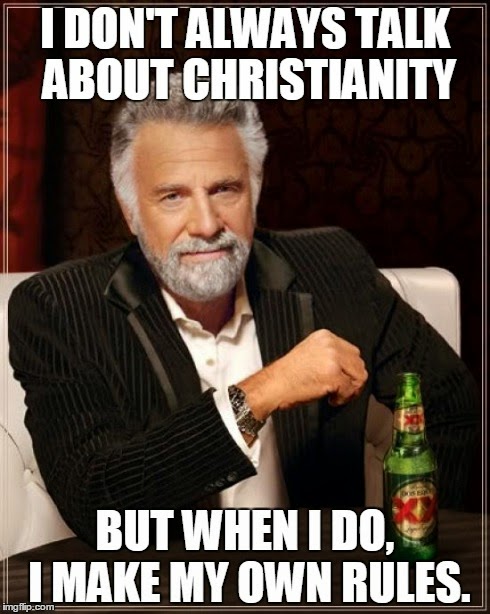
As stated in my first entry, I have noticed that the Atheist Meme Base community of Facebook regularly uses science to debunk or highlight contradictions in the Christian faith and in the Bible. I later narrowed my sample group down to memes that either pointed to contradictions in the Christian faith (in the Bible or in lived religion) or that use science to dispute Christian beliefs. I created this meme because it references the idea that Christianity ignores logic and science, which leads to it often contradicting these two areas. My meme also uses the forms of referential and phatic communication seen in my meme sample to provoke communication within their community and the outside world (basically, with any and all readers of the memes). This summary meme also highlights the irony of contradiction and uses this incongruity to create humor as demonstrated by the memes displayed by the Atheist Meme Base community.
Tuesday, November 18, 2014
Final Meme Blog: Reading Religion in Memes
For your final meme blog you are tasked with two reflections.
First you are asked to create a meme that summarize your key findings related to what messages and ideas about religion your study of Internet memes has revealed. Your meme should express in a succinct how your specific case study frames popular understandings about religion or the specific religious community under study. You should post your meme and then offer a 150-200 word explanation of what your summary meme seeks to express.
Second you are asked to compare your findings with one or two similar case studies from among your classmates to reflect on to what extent your findings echo or contrast their own and why you think this is so. This portion of the post should be 100-200 words and provide concrete examples/explanations to back up your claims.
Happy Blogging!
First you are asked to create a meme that summarize your key findings related to what messages and ideas about religion your study of Internet memes has revealed. Your meme should express in a succinct how your specific case study frames popular understandings about religion or the specific religious community under study. You should post your meme and then offer a 150-200 word explanation of what your summary meme seeks to express.
Second you are asked to compare your findings with one or two similar case studies from among your classmates to reflect on to what extent your findings echo or contrast their own and why you think this is so. This portion of the post should be 100-200 words and provide concrete examples/explanations to back up your claims.
Happy Blogging!
Thursday, November 13, 2014
Blog 5-How Memes Frame Religion
This week you are asked to reflect on the success strategies share in chapter 6 regarding what features and traits memes able to be reproduced, spread and easily repackaged. On page 95 Shifman provides and overview of what those key features are. Select and discuss 2 or 3 of these traits and how they frame ideas about religion in your memes.
Also Consider the different genre's of memes Shifman outlines in Chapter 7. To what extent does your meme collection correspond to one of these genres. If you were to identify a new genre of specifically religious memes what would it be. Share this new genre name and definition and how this communicate certain beliefs or assumptions about religion.
Also Consider the different genre's of memes Shifman outlines in Chapter 7. To what extent does your meme collection correspond to one of these genres. If you were to identify a new genre of specifically religious memes what would it be. Share this new genre name and definition and how this communicate certain beliefs or assumptions about religion.
Tuesday, November 4, 2014
Blog 4-Analyzing Rhetorical & Memetic Techniques in Memes
In this
week we focus our reflection reflect on the rhetorical and textual
elements of the memes under investigation, with special attention being paid to
how key symbols, shared ideas and beliefs about religion are
presented in your meme sample.
Your blog post should related to the principals discussed in Chapters 5 & 6 of Shifman's Memes in Digital Culture and the reflection activities from this week's meme research workshop. Specifically you are asked to respond to the following questions:
What common key symbols, shared ideas and values/beliefs that your memes focus on?
What are the dominant features of memetic and viral culture, employed by your meme sample?
What are the dominant forms of humor used in your memes?
How does that impact how religion and religious ideas/beliefs are framed?
Again, please highlight and describe three representative memes that express and illustrate these principals and the argument you are trying to make
Your blog post should related to the principals discussed in Chapters 5 & 6 of Shifman's Memes in Digital Culture and the reflection activities from this week's meme research workshop. Specifically you are asked to respond to the following questions:
What common key symbols, shared ideas and values/beliefs that your memes focus on?
What are the dominant features of memetic and viral culture, employed by your meme sample?
What are the dominant forms of humor used in your memes?
How does that impact how religion and religious ideas/beliefs are framed?
Again, please highlight and describe three representative memes that express and illustrate these principals and the argument you are trying to make
Thursday, October 30, 2014
Blog 3- Analyze Meme Construction and Communicative Techniques
In this week we consider how Internet memes are constructed and they ways these elements communicate meaning. We draw our definition for what is and Internet Meme from Limor Shifman who states in Memes in Digital Culture:
Internet memes are (a) a group of digital items sharing common characteristics of content, form and stance, which (b) were created with awareness of each other and (c) are circulated , imitated and transformed by many Internet users. (p. 41)
In your blog you
should blog related to the principals discussed in Chapters 3, 4 & 5.
Using the in class reflection activities focus your discussion on three
specific memes and how they seem to represent the common techniques and
communication
- Specifically
what are the common and dominant the visual and creative
techniques used in the creation of the memes you are studying?
- How do the common
characteristics of content and especially stance impact how your chosen memes
communicate messages about religion?
Tuesday, October 21, 2014
Blog 2-Defining Sample & Anatony of Memes
In week two you are asked to define your research sample of memes you will analyze. Each student will explore a totally of 12 memes and focus on three each week over the next 4 weeks. In this week's blog you should define your sample, select a specific framework, theme and/or time frame (for instance all memes should have been posted in the past 12 months). Explain and justify the sample you have chosen and provide hyperlinks to all of the memes to be analyzed.
Next you are asked to provide a thorough unpacking and anatomy of the meme genre or background of the meme group you are studying.
For those studying memes about religion you should answer the following questions: What are the components of the meme you are looking at (images, text, saying, characters) and where do they come from? How do these elements and how they are assembled impact the meaning of the meme and messages they spread about reading? Provide three concrete example of and show how they illustrate this.
For those studying religious memes you should answer the following questions: What is the background and mission/focus of the group posting about memes you are studying? How does this impact the kinds of memes they present, create and or circulate? What seem to be the common themes this group expressed? Provide three concrete example and explain this.
Post these response on your individual blog by 5pm on Friday.
Next you are asked to provide a thorough unpacking and anatomy of the meme genre or background of the meme group you are studying.
For those studying memes about religion you should answer the following questions: What are the components of the meme you are looking at (images, text, saying, characters) and where do they come from? How do these elements and how they are assembled impact the meaning of the meme and messages they spread about reading? Provide three concrete example of and show how they illustrate this.
For those studying religious memes you should answer the following questions: What is the background and mission/focus of the group posting about memes you are studying? How does this impact the kinds of memes they present, create and or circulate? What seem to be the common themes this group expressed? Provide three concrete example and explain this.
Post these response on your individual blog by 5pm on Friday.
Tuesday, December 3, 2013
Networked Religion Through Devotional Twitters
My case study looked at daily devotions on Twitter. I wanted to learn what types of tweets were best received by the followers of the account for Our Daily Bread. In terms of Networked Religion, devotions on Twitter can be classified as Storied Identity. "The social sphere offers individuals various resources and meanings from which they can select, assemble, and present a sense of self" (Campbell, 2011, pg. 8). Our Daily bread offers a variety of tweets that cater to all of their followers. Followers choose which devotion best suits their life, and respond and react to those tweets; followers gain a sense of identity through the tweets they choose. Storied identity offers new possibilities for assembling a religious identity for those lacking opportunities offline. Interactions between Our Daily Bread and the account's followers not only provide a spiritual message, but also create a religious identity. As mentioned previously, Our Daily Bread provides a variety of tweets spanning from a broadcast type tweet to a more personal level tweet; "Here the self may be assembled through a variety of different resources that create a distinctive narrative" (Campbell, 2011, pg. 8). Followers are given the chance to not only live their religion online, but also create a religious identity. Storied identity is constructed and performed online and encourages a malleable self-presentation. The account's interactions with followers, most importantly the tweets they send out daily, have proven to be an influential performance of religion. The findings from this research proved that Twitter is a popular place for religion, and that it is being used for different meanings. The devotional Twitter accounts allow followers to express their religious views to their own followers, but even more so,use the religion to get through their own lives. Provided is an example of the various types of tweets I observed during the case study research; tweets included scripture based devotions, broadcast devotionals, and short inspirational messages (which proved to be the most effective and well received).


Monday, December 2, 2013
Storied Identity in Instagram
My case study
was about the use of the hashtag, “blessed” on Instagram. This study was aimed
at looking at the ways that individuals are expressing lived religion in their
lives and whether or not they intended for religious meaning or secular meaning
to be drawn from the ways they were posting. This case study revealed a heavy
emphasis on “storied identity”, which Campbell identifies as acknowledging “that while identity
construction is a process lived out online and offline and mirrors the
understanding that while people often play with multiple identities, there is
still often a push to unify them.” (Pg. 11). This shows that people have
multiple aspects of their identities that can be very unique from each other. However,
storied identity says that these forms of identity can be melded together to
make the whole identity of the individual. The people that I studied were using social
media to construct an image of themselves through the picture and words that
they posted. While one post can only reveal one part of the person’s identity,
a lot can be gathered about what they think about certain things as well as
what they value from one post. For example, one user posted “blessed” as well
as the terms “cleaning” and “offday”. Through this, different parts of this man’s
identity are revealed. He values the time off he has from his job, and enjoys
the accomplishment that cleaning brings. These two terms add to his feeling of
being blessed. However, that is only my interpretation of the post. Others
could analyze it in a different way, which adds to the idea that use religious
words, such as blessed, in a fluid way. They can mean that they feel happy or
they can mean that they actually feel blessed. The bottom line is lived
religion is growing through the various ways that a person can now express
themselves.
Campbell,
H. A. (2012). Understanding the Relationship between Religion Online and
Offline in a Networked Society. Journal Of The American Academy Of Religion,
80(1), 64-93.
Networked Religion, Non-Denominational Churches, and Facebook
My case study looked at how non-denominational Christian churches used Facebook to spread their interpretation of the Christian message to their members and followers. I wanted to see how Facebook was used to spread these messages as well as how members responded to the Facebook posts. Non-denominational churches are very big into allowing their members to make their own interpretations of the message by allowing them the freedoms that are not offered to them through traditional christian churches.
In lecture, we learned that "Networked religion represents a loosening or re-presentation of traditional boundaries of religious communities to reflect more dynamic and fluid forms of affiliation and practice". The way these non-denominational churches use their Facebook page reflect this idea in several ways.One way that these churches do this is they include their interpretation or what they believe the take away message from different media content about Christianity with their posts. This not only provides the traditional message, but it also offers these church's re-presentation of the content that is being presented so that followers can understand that their is different interpretations of the traditional content, and they are able to make their interpretations as well.
Another aspect of Networked Religion that these non-denominational churches portray is that of Multi-site Reality or embedded online to offline connections. One church in particular that I observed was Riverpointe Church of Richmond, TX. This church uses media content to portray their message very often, and everything that they include in their sermon, they also post online in case some members were unable to make it to church on Sunday. This not only includes different youtube videos that they have either made themselves or have found online, but this also includes podcasts of the sermon that was presented that Sunday. This brings the sermon found offline at church on Sunday online for those members that may have been out of town that weekend or just weren't able to make it in time for the offline sermon.
Another aspect of Networked Religion that these non-denominational churches have used is that of a Networked community, or loosely bounded social networks. This can be seen through the use of hashtags that encourage members to participate and discuss particular content that is posted, and allows these members to share their voice with each other. Through these hashtags, members are talking directly to each other, but they are still very loosely connected through the one linked hashtag. When you click on the hashtagged message, you are able to see all of the different messages that have been posted by members based off of the one message that was posted originally by the church.
Facebook is one of the top social media sites for a reason, and these non-denominational churches have taken advantage of this in several ways. They have brought their message from offline to online, and have allowed members to connect with each other as well as with other christians by allowing them to share their own interpretations of the message posted by the church. This is only one way these churches have been using social media to communicate and build a network within their religion, and has technology continues to grow and evolve, I believe it is only a matter of time before we start seeing certain churches that operate solely online.
In lecture, we learned that "Networked religion represents a loosening or re-presentation of traditional boundaries of religious communities to reflect more dynamic and fluid forms of affiliation and practice". The way these non-denominational churches use their Facebook page reflect this idea in several ways.One way that these churches do this is they include their interpretation or what they believe the take away message from different media content about Christianity with their posts. This not only provides the traditional message, but it also offers these church's re-presentation of the content that is being presented so that followers can understand that their is different interpretations of the traditional content, and they are able to make their interpretations as well.
Another aspect of Networked Religion that these non-denominational churches portray is that of Multi-site Reality or embedded online to offline connections. One church in particular that I observed was Riverpointe Church of Richmond, TX. This church uses media content to portray their message very often, and everything that they include in their sermon, they also post online in case some members were unable to make it to church on Sunday. This not only includes different youtube videos that they have either made themselves or have found online, but this also includes podcasts of the sermon that was presented that Sunday. This brings the sermon found offline at church on Sunday online for those members that may have been out of town that weekend or just weren't able to make it in time for the offline sermon.
Another aspect of Networked Religion that these non-denominational churches have used is that of a Networked community, or loosely bounded social networks. This can be seen through the use of hashtags that encourage members to participate and discuss particular content that is posted, and allows these members to share their voice with each other. Through these hashtags, members are talking directly to each other, but they are still very loosely connected through the one linked hashtag. When you click on the hashtagged message, you are able to see all of the different messages that have been posted by members based off of the one message that was posted originally by the church.
Facebook is one of the top social media sites for a reason, and these non-denominational churches have taken advantage of this in several ways. They have brought their message from offline to online, and have allowed members to connect with each other as well as with other christians by allowing them to share their own interpretations of the message posted by the church. This is only one way these churches have been using social media to communicate and build a network within their religion, and has technology continues to grow and evolve, I believe it is only a matter of time before we start seeing certain churches that operate solely online.
Subscribe to:
Posts (Atom)